Deviation numbers
During a project, things happen that nobody planned. Bad weather, a damaged road, an accident, or broken equipment can cause standby and delays. A deviation number gives each such cause its own number and name, for example 1001 Weather Delays. When people record standby or extra work in a daily report, they pick the deviation number that caused it. SUM-IT then adds up the hours and costs for each deviation, so you can see what each cause cost the project.
On the Deviation numbers tab you define these numbers. Each organization can also add its own estimated cost and choose which deviations it wants to follow closely. The cost of the deviations is shown on the Track deviations and Deviation details reports, and on the Project overview report.
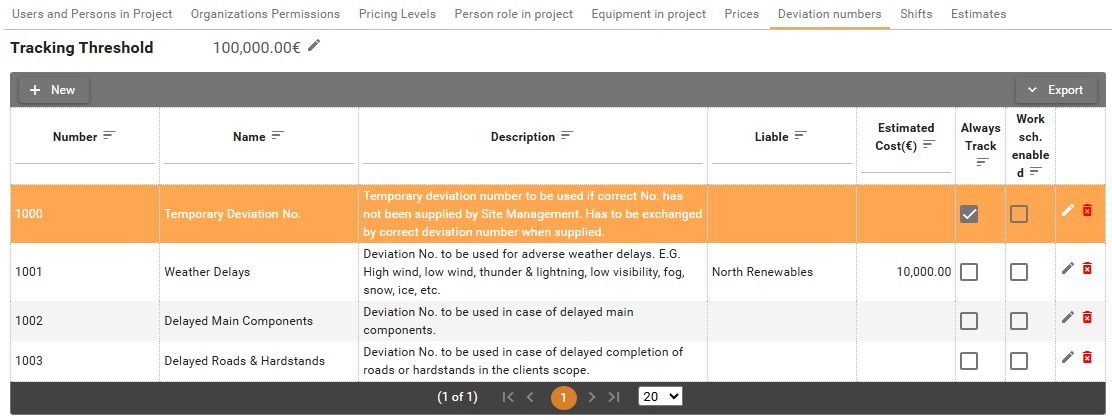
All organizations in the project see all deviation numbers. Only the project owner can create them. The estimated cost and the tracking settings belong to your organization, and other organizations do not see them.
Permissions
The screen is visible for the users with View permission on Project Configuration -> Deviation Numbers functionality. Users with Create/Edit and Delete permissions can change deviation numbers, but what they can change depends on the organization:
-
The project owner organization can create, edit, and delete all deviation numbers in the project. Only the project owner can change Work schedule enabled.
-
Subcontractors and clients see all deviation numbers, but they cannot create, rename, or delete them. They can add their own estimated cost, tick Always Track, and set their own tracking threshold.
The project owner can also open this list from a daily report. In the activity dialog, the plus button next to Deviation No. opens it, so you can add a missing deviation without leaving the report.
Tracking threshold

The tracking threshold is one amount for your organization, and it applies to every deviation. When the cost registered against a deviation reaches this amount, the deviation appears on the Track deviations report. That cost adds up the hours of all activities linked to the deviation and the expenses linked to it.
To change the amount, click the pencil next to it. Then click the tick to save it, or the cross to cancel. Each organization sets its own threshold.
Always Track
Tick Always Track on a row when you want that deviation on the Track deviations report all the time, whatever its cost so far. This choice is saved for your organization only.
You see Tracking Threshold and Always Track only when your organization has full access in this project. See Billing.
Work schedule
Most deviations explain standby and extra work. Sometimes you also want planned work to count under a deviation. For example, the main crane is broken, and while it is repaired the riggers do the planned preassembly on the ground. You may want those planned hours counted under the deviation for the broken crane as well.
Work sch. enabled in the table is the same choice as Work schedule enabled in the dialog. Tick it when people should be able to choose this deviation on a Work Schedule activity. On a Work Schedule activity, the Deviation No. list shows only the deviations that have it ticked. Extra work and Stand by activities can use every deviation, ticked or not. A new deviation starts unticked.
-
The checkbox in the table is saved as soon as you change it.
-
Once the deviation is used on an activity, you can no longer untick it. SUM-IT shows a message and keeps the tick.
-
In a daily report, if someone changes an activity to Work Schedule and its deviation is not ticked, the Deviation No. field is cleared. They then choose a deviation that is allowed, or leave the field empty.
Creating, editing, and deleting a deviation number
-
Click New to open the Create Deviation number dialog. Only the project owner sees New.
-
Click the Edit button
 , or double-click a row, to open the Edit Deviation number dialog. If another organization created the deviation, the dialog shows only the fields that belong to you: Estimated Cost and Always Track. Work schedule enabled is shown, but greyed out.
-
Click the Delete button
 to delete the deviation. SUM-IT asks Do you want to delete deviation: followed by its number. Click Yes to delete it, or No to keep it. Only the organization that created the deviation can delete it. A deviation that is already used, for example on an activity or an expense, cannot be deleted. SUM-IT then shows Cannot delete this record, because of dependencies.
-
Use Export -> Export to Excel to download the table as a spreadsheet.
Create/Edit deviation number dialog
-
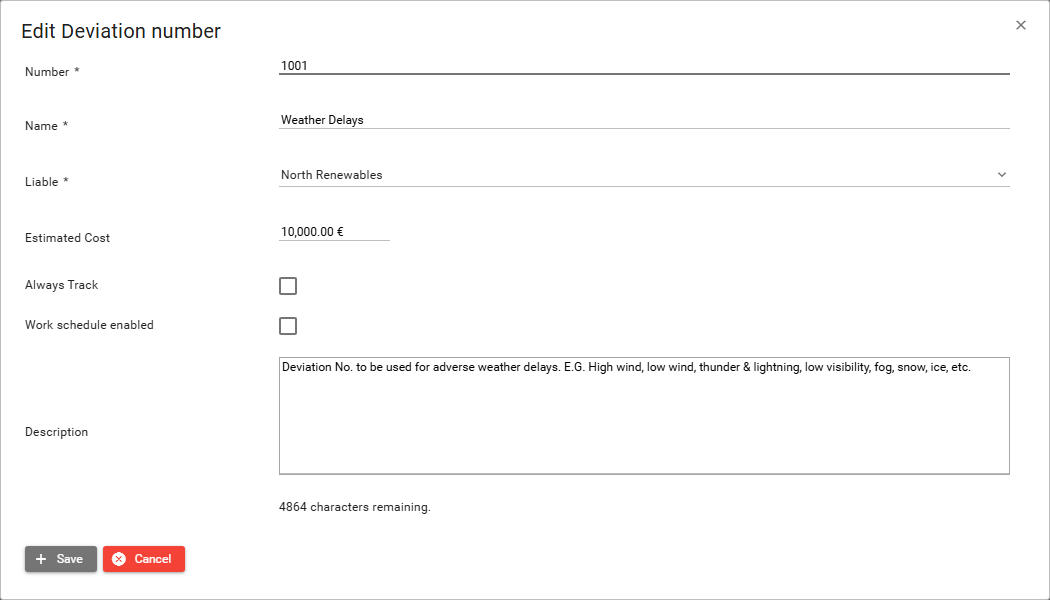
Number (required). A whole number. Each number can be used only once in the project. If the number is already taken, SUM-IT tells you that a record with the same data already exists.
-
Name (required). A short name for the cause, for example Weather Delays.
-
Liable (required). The organization responsible for the deviation. You choose it from the organizations in the project. It is shown on the Deviation details report.
-
Estimated Cost (optional). Your organization's estimate of what the deviation will cost. When the registered cost reaches this estimate, the deviation appears on the Track deviations report.
-
Always Track (optional). The same choice as the checkbox in the table.
-
Work schedule enabled (optional). Lets people choose this deviation on Work Schedule activities. See Work schedule above.
-
Description (optional). Up to 5000 characters. A counter under the field shows how many characters are left.
Click Save to store the deviation. Cancel closes the dialog without saving.